總網頁瀏覽量

2018年9月9日 星期日

Another Tremor from Hokkaido: Kita no sakuramori(北の桜守) Sakura guardian in the North

On 6th September Hokkaido was devastated by a 7.6 Richter scale earth tremor which left a dozen dead, more than double that number missing, some 150 injured and 3 million people without electricity. Today, the effects of another kind of tremor from that part left me completely dumbstruck: I felt the combined power of sight and sound, from Yojiro Takita, a veteran director who took 7 years to produce a film which leaves one completely shell shocked with emotional dynamite within the cosy darkness of a movie theatre. The film is called "Kita no sakuramori"(北の桜守), in English, Sakura Guardian in the North. 

I was totally unprepared to receive the shock, having just seen one previous film from this director, Departures,《送行者:禮儀師的樂章》which won an Oscar as the best foreign film  in 2009. Like the previous film, it's about a universal theme; the emotional bond between a son and an estranged parent. Whereas the previous film was about reconciliation between a son and a father, this film is about that between a son and his long lost mother. Between the start of the film and its end, we were exposed to a piece of Japanese history, a parallel stage play, the breathless beauty of Hokkaido, a tale of undying love of a widow for a solider husband who died in a forced labor camp in Siberia, an unrequited love between her and first her benefactor, a blackmarket rice dealer during the last stages of the Second World War who later became a disappointed suitor and now the proprietor of a huge and prosperious logging enterprise and Mari (Ryoko Shinohara) the beatiful modern day American-born Japanese wife of the widow's son Shujiro Ezure  (played by Masato Sakai) (now the CEO of the first American hot-dog chain to open in Sapporo, Hokkaido), completely baffled by the apparently inexplicable behavior of her husband, once the latter suddenly got news of his mother., now forced to close down her illegal traditional  style Japanese restaurant in Abashiri ,in the remote north part of Hokkaido.

The film opens with various scenes in a dance theatre featuring the widow, Tetsu Ezure(played by the 73-year-old movie diva Sayuri Yoshinaga who seems totally untouched by time), we see how her husband Yokujro (Hiroshi Abe) who  was forced to leave the then Japanese colony Sakhalin island to fight the Russians when the Soviet Union suddenlly declared war on Japan in 1945, leaving her behind with two young kids Shujiro and his elder brother. Before he left, he told his elder son to take care of the mother and to rejoin him in another town at the next full moon when the Sakura would be blooming.  We hear singers dressed in American style Protestant church choir chanting a song in praise of the Sakura when it first bloomed in Sakhlain, with seeds first brought there by Yokujiro, when the film begins,with neighbors staring in open-mouth wonder at that amazing sight. 

Then the film flashes back and forth between 1945, when the story begins and 1971, when the story really develops. We see how during the war,a tired looking Tetsu drag her even more exhausted son in the wilderness until the driver of a lorry passed by, took pity on the starving down and out pair, still trying heroically to refrain from begging for food, how instead of raping her as suggested by his lorry attendant, he gave her a job as a porter gathering bags of blackmarket rice thrown off a passing train, how fellow students taunted Shuijiro as the child of a family selling black market rice in the playground, how Tetsu asked him to fight back, how she lost her elder son who drowned whilst trying to grab at a lifebuoy for her and his younger brother Shuijro when the ship which took them from from Sakhalin to Hokkaido was torpedoed, how he lent her money to open her humble restaurant, how Shuijiro, who thought that he had been abandoned by his mother once he reached adolescence, would still abandon everything once he got news that her mother, now suffering from occasional dementia, got into trouble: wandering off at night to seal up a hole in a sakura tree in the municipal park in Sapporo with rice paste and black ink to protect it from the cold, how she caused inconvenience to her uncomprehending daughte-in-law when she mistook anohter's shoes for her own after she left the changing room of a department store, how she causes smoke in the son's little yard to the complaints of his son's neighbor whilst trying to cook some sashimi with wood fire to make it taste better, how she took some green onion from a vegetable stall without paying for it there and then, thinking that she could have it on credit, as in her native town etc and how Mari could never understand why Shuijio would abandon his work to be with her on the slightest news that she needs help. 

It was a most Japanese film. We experience in concrete the symbolic values of the Japanese sakura: its quiet and unassuming sturdiness, it steadfast faithfulness, its unpretentious dignity and how the sakura would burst into full bloom with its evanescent and fragile beauty, and how its delicate petals would gently rain down from the tree upon the sligtest spring breeze, drifting softly in the air, year after year and yet somehow never quite far away but always colored by a tinge of quiet melancholy and in particular its intensely personal meaning for the Ezure family--the heart-breaking longing for a family reunion which is forever stlll to come, perhaps, realizable only in a different kind of land, perhaps another faraway world, a world of love, of tenderness and of dreams... .  

I like the way Yojiro Takita presents his theme, with images, with sparing speech, with carefully composed shots and with superb use of lights etc. Especially touching is the way  he shows how Tetsu has learned to talk to her own image in the mirror in her loneliness in the long years her son has left for America to seek his fortune, the way she kept returning to various spots which had emotional meaning for her in her unfortunate past, the way she talks to the sakura tree, as if it had ears to listen to her, the way she would struggle up a steep slope to give thanks to the local god at a shrine perched high up the mountain of Abashiri overlooking Sakhalin that she and her family is still surviving despite all difficulties, how during her last climb, she was joined by Shojiro and how when the film ends,  she was found by her former suitor to be working in a sakura tree farm in Hokkaido two years after she rejoined her son and then left without a word and how when she was found again, through a tip from her former suitor and benefactor, Mari appearing with a newly born baby, standing next to Tetsu's former suitor and the neighbor who betrayed her husband as part of the group of 15 Japanese prisoners of war in Siberia, who later let her off when she was caught during a police raid of the rice smugglers in one of their routine operations. It's a celebration timmrsed completely into the sound of the beautiful song in praise of the sakura, a hymn to the final reconciliation between mother and son and all who had ever a part in their lives. At that moment, she saw again  the image of her long dead husband, with his two favorite sons, one on each side, walking towards her, his face beaming with joy. She had no need for anything else under the blooming sakuras.

The acting was superb, the cinematography likewise .The rhythmic motion of the troupe of dancers moving gracefully on the stage in silence marks out various episodes in Tetsu's past,  interweaving them seamlessly into each other and confers a unique kind of artistic unity to this most moving hymn on celluloid to the unreakbale bond between mother and child. .If Yojiro Takita has shown how he could titillate our senses in his former  series of pink films, he demonstrated in this 126 minute-epic how he could equally draw tears from the most hardened hearts without the slightest difficulty. 

2018年1月1日 星期一

Colors of the New Year (新年色彩)

It's been a while since I posted anything in this blog. But I haven't got a call from the Grim Reaper yet. If there's been  a complete blank out here, I have every reason to shift the blame on to the shoulders of the likes of Spinoza, Leibniz, Kant,Hegel, Husserl, Heidegger, Foucault, Derrida and Deleuze. But the lure of lights, shadows, colors and forms remain as fatal as ever and the clicks of the camera of that black box called the camera remain music to my ears.  
The new year always arrives with  mixed feelings for me: the past is gone and future is yet to come and it's understandable that many feel that that it's as good a time to make a new start as any other. And so, with trepidations and fumbling fingers, I clicked the "write" icon and tried my best to recall how to put together a new blog again
.  

It's mid-winter but it doesn't stop the silent explosion of life.

2017年7月14日 星期五

Getting Acquainted with the WKCD (認識西九文化區)

I've heard and read bits and pieces about what's come to be called the West Kowloon Cultural District (WKCD) for a while but I never visited the site after actual construction of the relevant facilities began in earnest. Yesterday, I did so.


I first had to cross the highway serving the Western Harbour Crossing tunnel from the Kowloon Station of the MTR's Tung Chung Line to the seafront

2017年7月10日 星期一

A new adventure (新冒險)

I'm familiar with D'Aigular Street in Central. But I never knew until recently that's there's a beautiful place called Cape D'Aguilar, or Hok Tsu. It's a cape south of Shek O on the south-eastern tip of Hong Kong Island.  The cape is named after after Major-General George Charles D'Aguilar.


I got off the at the intersection of Shek O Road and Cape D'Aquilar Road and walked along the road for some 10 minutes before arriving at the road actually at a round about where I discovered that in fact, It's served by Route No. 9 Bus.  There were plenty clouds in the sky.

2017年7月8日 星期六

Pingxi ( 平溪)

Pingxi District ( 平溪區)  is where the Keelung River begins( in fact it starts Jingtong) In early 20th century, the Pingxi town itself was an important coal mining  centre. The area was first settled in the 1870's when the local population started growing a plant called in Chinese 大菁(大青)or 細葉臭牡丹、臭腥公、山尾花、淡婆婆、鴨公青、山漆, used in the preparation of blue dyes but with the growing use of artificial dyes that declined and the population switched to growing Ooloong tea (大葉烏龍、青心烏龍)  as well as 青心大冇 and 硬枝紅心.  In 1920's the Poon and Ngan clans began mining coal in the area. At its height, it had more than 20 such mines. But in the 1970s, with the  import of petroleum, coal mining declined and its days of glory are over. Now the population has dwindled to only less than 5,000. The Pingxi District is however very rich in water resources. It's got more than 200 rainy days per year with average rainfall of 3,500 mm each year. In 1912, it had a record 8,500 mm and in 1986, 6224 mm. It's also known for its 36 waterfalls.   
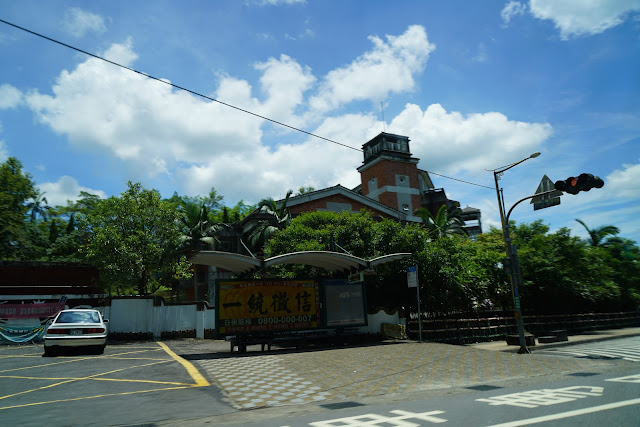

 
My first view of Pingxi,a rural district in eastern New Taipei City in northern Taiwan, the average age of whose population is more than 50 compared to the national average of about 38 and is the highest in the whole of Taiwan. 

2017年7月7日 星期五

Jing Tong (菁桐)

The next stop in my short Taiwan trip is a small town along the old diesel engine railway line called the Pingx Line (平溪線): Jing Tong(菁桐)  The small railway station was built in 1929 to serve this small coal-mining community. At its height, it boasted more than 10,000 inhabitants. With the global switch from coal to petroleum and natural gas as energy, the nature of the town's economy is completely transformed: from mining to tourism. In 2003, it was declared a cultural heritage by the Taiwanese Ministry of Culture.  It was not always called by its present name. It used to be known as  菁桐坑驛. The station underwent some renovation in 2014-2015.


There's a prominent sculpture to mark its historical past right at the side of the road close to the local police station. 

2017年7月6日 星期四

Cape Santiago Lighthouse(三貂角燈塔)


Our last stop for the day was to be a famous lighthouse at a place which got its name from the Portuguese when they first came here in 1626 and built a small fortification: Cape Santiago, translated into the local dialect as  "三貂角"


According to internet sources, this lighthouse was built by the Japanese governor shortly after two Japanese ships sank off its coast, one after another, the first in 1929 and the other in 1931. It was commissioned in 1935. The tower is some 16.5 metres high but its lights project up to more than a hundred metres from the ground up. It flashes out both white and red lights. The white light has a range of some 24.5 nautical miles whilst the red some 20. The lights make one complete turn every 28 seconds. The white light streams out continuously but the red flashes only intermttently.


2017年7月5日 星期三

Magang Village (馬崗村)

Our third stop of the day is a small fishing village most of whose youngsters have moved to seek their fortunes in Taipei. It's at the eastern-most tip of Taiwan. It's the Magang Fisherman Village (馬崗漁村)


 Many of the old houses in the village are now deserted and left in ruins

2017年7月4日 星期二

Wave Power (浪能)

After a foretaste of the inventiveness and immensity of Nature's sculpture near to the fishing port of Cape Shen O (深澳岬) our car sped along the highway to our second point of interest. 


After parking at a passing place, we had to go down a path, crossed the highway by following a stony path passing under tiny bridge to reach the seaside.

2017年7月3日 星期一

Destination North Taiwan (終點北台)

As far as our politics are concerned, it's clear whose flag is up and whose down.


But whether our flag is up or down, one can always fly away, at least for a time and visit some exotic places, where the eating habits are quite different.

2017年6月25日 星期日

Nothing Ever Stays the Same (無常)

These days, the weather seems extremely unstable. I wonder whether that's got anything to do with global politics. There are changes everywhere, and sometimes, not necessarily in the kind of directions we would like to see.


But the flowers don't seem to care.

2017年5月31日 星期三

After the Dragon Boats, the Dragon Trail Clouds(龍舟過後龍脊雲)

It's often said that the Chinese dragon brings rain.


But this year, it brought merely clouds but no rains


and merely a blue sky.


The clouds were hovering over our hills,


extending as far the eyes could see


and over the sea.


some were streaking across the sky


branching out like leafless trees in the sky


But they didn't dim our sea


Nor did they dull the colors of our golf courses


They're everywhere


But no torrents, merely currrents.


some took to the beaches


But not too many


Perhaps it took time for the Dragon Boat Festival dumplings to be digested, leaving on our beaches nothing but little waves to lap against the shore. .


2017年5月30日 星期二

Reflectiions (反照)


Dragon Boat Festival today.


If you wish to see dragons, you're more likely to be elbowed about

2017年5月28日 星期日

The call of Ra(拉的呼喚)

For quite a while, we have had nothing but grey skies, fuzzy fogs and even a black rainstorm or two.


So it's a real delight to see the sun again

2017年5月17日 星期三

A quiet day (悄悄的一天)

Went to a religious dialogue session at the Tsimshatsui Mosque and then a French movie at Admiralty. 


Between the two, I took the opportunity to visit two parks but didn't find much of interest

2017年5月16日 星期二

A sunless day (沒陽光的曰子)

The sun may not have decided to bestow his glory upon us.


But that need not mean one is completely helpless. 

2017年5月3日 星期三

Another experiment (又一個實驗)

Felt a bit bored with all my studies of the conscious, the sub-conscious, the personal  unconscious and the collective unconscious. What better to distract myself than a borrowed lens?


Product of ennui at the ferry

2017年5月1日 星期一

A Sigh of Relief (吁一口氣) !

How could my new lens have performed so badly? That's what bothered me last night. What did I get wrong?


When I cast my eyes at the light compensation button, all became clear.